
Signs You May Have Macular Degeneration
Macular degeneration can cause changes that affect your central vision. This age-related eye disease is one of the most common reasons why people experience vision loss, according to the National Eye Institute. Recognizing the signs and symptoms of age-related macular degeneration (AMD) can help you get the care you need to slow the progression of the disease and maximize your vision.
What Is Macular Degeneration?
The macula occupies the center part of the retina, a layer of light-sensing cells at the back of your eye. The cornea (the clear tissue covering your iris and pupil) and the lens inside your eye focus light onto your retina. Once light reaches the retina, it is transformed into electrical impulses. The impulses travel along the optic nerve to the brain where they're converted into images.
Macular degeneration occurs when the cells in the macula become damaged. When macular cells are damaged, the brain receives incomplete information from the eyes. As a result, you may notice changes in your vision. AMD can affect just one eye or both of your eyes.
Although anyone can develop AMD, the American Academy of Ophthalmology (AAO) notes that your risk may increase if:
- You're 50 or older
- Other people in your family have or had AMD
- You're overweight
- You have high blood pressure
- You eat foods that contain saturated fats
- You smoke
Macular Degeneration Signs and Symptoms
You may have one of these two forms of macular degeneration:
- Dry. Most people have the "dry" form of macular degeneration. In this form, the cells in the macula gradually become thinner and die.
- Wet. Wet AMD happens when abnormal blood vessels begin to grow in the macula. These blood vessels often leak, interfering with vision and creating scars. Dry AMD can turn into the wet form in some cases.
If you have AMD, you may experience these signs and symptoms:
- Blurred Vision. Blurry central vision can be a sign of AMD.
- Dull Colors. Do colors look dull or faded? That's not surprising since your macula is responsible for good color vision. If macular cells are damaged or die, colors won't look as rich and vibrant.
- Wavy Lines. AMD distorts straight edges and lines, making them look wavy.
- Blind Spot. Eventually, you may notice a blind spot in your central vision. As central vision is essential for reading, driving and recognizing faces, a blind spot can have a serious impact on your life.
- Trouble Seeing in Low Light. AMD may make it difficult to read or see in low light or adjust quickly when walking from a dark room to a light room.
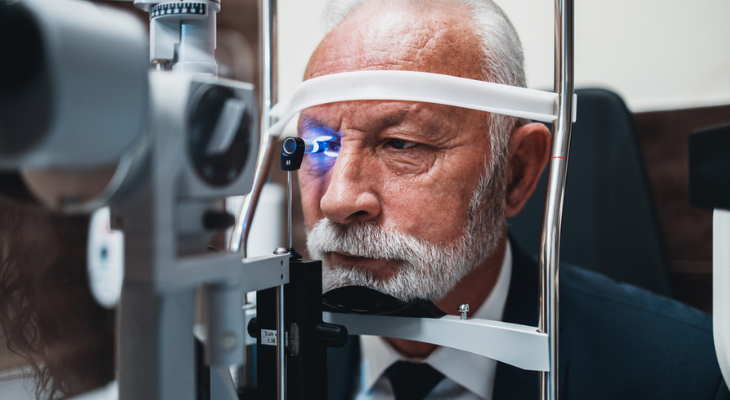
During your visit to the eye doctor, your eyes will be dilated so that any drusen that may have formed can be detected. Drusen are yellow, fatty deposits that form under the macula. If you have drusen, you may already have dry AMD or may be more likely to develop the eye disease.
Treatments for AMD
Eye doctors treat wet AMD with injections or laser treatments that slow leaks and decrease the number of abnormal blood vessels in your macula.
Although there is no treatment for dry AMD now, taking AREDS supplements may help slow the progression of AMD, according to the American Academy of Ophthalmology. The supplements contain lutein, zeaxanthin, zinc, copper, and vitamins C and E. Wearing sunglasses that protect your eyes from ultraviolet A (UVA) and ultraviolet B (UVB) rays can also be helpful, as can eating a healthy diet and avoiding smoking.
Scientists are hard at work looking for treatments for the dry form of AMD. According to Bright Focus Foundation, researchers are exploring a possible immune system link to AMD, investigating an implant that slowly releases a protective medication, researching eye drops that improve blood flow to the retina, and conducting several other AMD studies.
If you have already experienced vision loss due to AMD, your optometrist can recommend low-vision aids, like magnifiers, telescopes, special eyeglass lenses, and large-print books and products.
Sources:
National Eye Institute: Age-Related Macular Degeneration (AMD) Data and Statistics, 7/17/2019
Bright Focus Foundation: The Latest Research on Dry Age-Related Macular Degeneration, 7/9/2021
All About Vision: What Is Macular Degeneration?, 3/2022
American Academy of Ophthalmology: What Is Macular Degeneration?, 2/10/2022